Invasive plants do not stop at the edge of a conservation trail, wetland, roadside, or backyard fence. They spread by seed, root, vine, bird, wind, water, yard waste, and well-intentioned landscaping choices. That’s why Wayland’s effort to control invasive plants cannot succeed on public land alone. Private homeowners’ participation is also essential.
The Wayland Conservation Department has direct legal oversight and field management responsibilities over more than 19 major town-owned conservation parcels and open spaces. They actively audit trail health and prioritize target zones for community-led and professional removals.
The Conservation Commission has recognized invasive plants as a serious environmental concern. The town manages invasive species on public conservation lands and bodies of water through targeted removal, biological controls, and active oversight by the commission.
One biological control is supporting the propagation of native insects and specific, thoroughly vetted predators such as the Galerucella beetle for purple loosestrife that selectively target and feed on aggressive invasive species without harming native flora.
Another is utilizing specific native groundcovers, such as tall fescue, and heavy native replanting initiatives. By aggressively establishing native canopies and root systems immediately after an invasive removal, the town uses natural plant competition to starve invasive seeds of sunlight and nutrients.
The committee also requires residents to coordinate and obtain permits for any vegetation work near protected resource areas. Because many invasive patches grow near sensitive environments, the Conservation Commission regulates any cutting, clearing, or grading within 100 feet of wetlands or 200 feet of perennial streams.
Educating residents about invasive plants and encouraging residents to police their yards is another strategy. The town’s invasive species information page explains that invasive plants grow rapidly, reproduce aggressively, out-compete native plants, reduce biodiversity, and can form monocultures where one species dominates an area that once supported a healthier variety of plants and wildlife. For more information, see cisma-suasco.org/invasive.
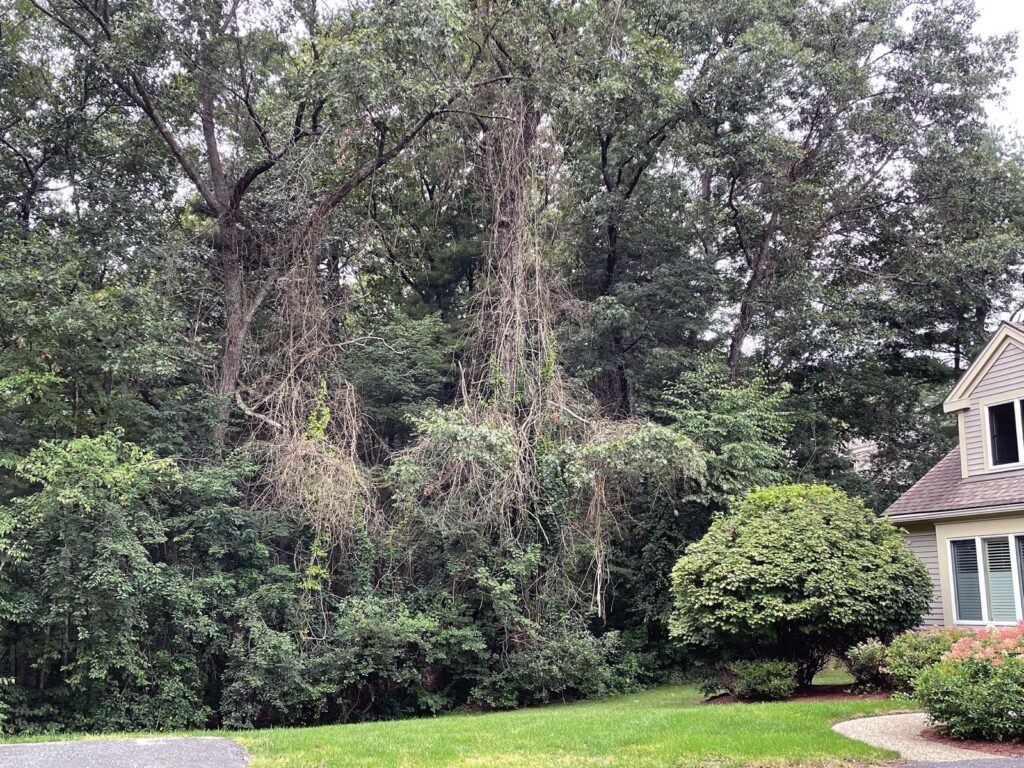
For homeowners, the invasive-plant problem is not abstract. Invasives in one yard can become invasives in the next yard, then in a nearby wetland buffer, and eventually along a conservation trail. Plants such as bittersweet, multiflora rose, burning bush, barberry, garlic mustard, Japanese knotweed, phragmites, and Norway maple can crowd out native shrubs, wildflowers, and young trees, along with the insects and birds that depend on them.
Homeowners can make a real difference. A single property may seem small, but Wayland is made up of hundreds of private properties. Together, everyone’s yards form a large part of the town’s habitat network. What residents plant, remove, mow, dump, or ignore affects the health of Wayland’s wetlands, woods, streams, pollinators, and birds.
Wayland’s town staff and Conservation Commission can establish priorities and manage public lands. But they cannot control what grows in every backyard. That responsibility belongs to all residents. If each homeowner removes even one invasive plant and replaces it with one native plant, Wayland will be healthier. If neighborhoods work together, the impact will multiply. Invasive-plant control is not only a town project. It’s a town-wide team effort, and every yard counts.
Wayland’s Green Community designation shows what can happen when a town sets environmental goals and follows through with sustained local action. Invasive-plant control deserves the same community-wide commitment.
Wayland’s broader commitment to environmental responsibility is reflected in its designation as a Massachusetts Green Community (MGC), a status the town has held since 2010. To receive that designation, a municipality must commit to reducing energy use by 20% over five years and meet additional state criteria on energy efficiency and clean-energy development. MGCs become eligible for state grants, technical assistance, and support for energy-saving projects in municipal buildings, schools, facilities, and vehicles.
The Green Communities program is primarily focused on municipal energy use and greenhouse gas emissions; it does not directly regulate invasive plants on public or private property. But the designation reflects an important principle that applies equally to ecological stewardship: meaningful environmental progress requires measurable town action combined with residents’ participation. Protecting Wayland’s ecosystem should be viewed as part of the same broader commitment to creating a healthier, more resilient community.